September 15, 2026 |
Author: Ben Smith |
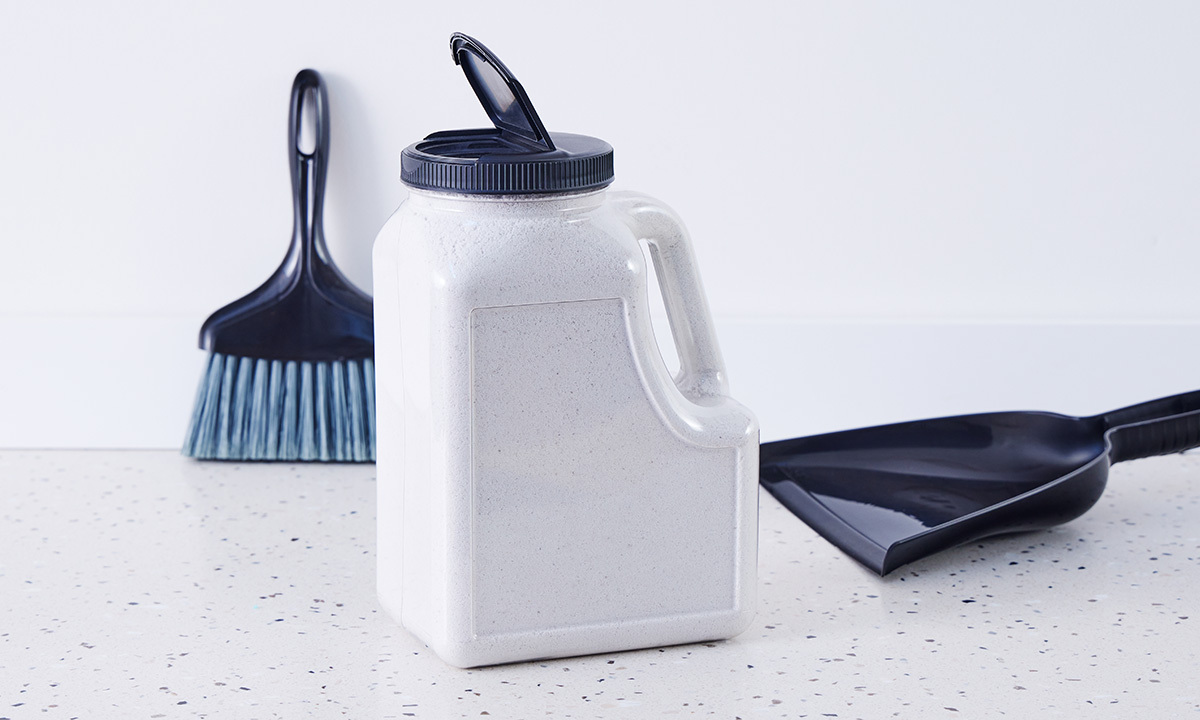
Cleaning products live a demanding life inside their packaging. Bleach, ammonia, degreasers, and concentrated surfactants sit in direct, prolonged contact with a container’s walls, often for months, through temperature swings in a warehouse, a delivery truck, or a customer’s cabinet under the sink. Household and chemical packaging has to hold up to all of it without cracking, leaching, or compromising the product inside, which makes material selection one of the most consequential decisions a brand makes before a single bottle ships.
For brands in this category, that decision almost always leads to the same material: high-density polyethylene. Flexcraft has spent decades manufacturing HDPE bottles, jugs, and canisters for household and chemical brands, and pairs that material expertise with a deep in-stock inventory that lets brands launch new products or scale existing lines without waiting on custom tooling.
Unlike food or personal care products, many household chemicals are formulated to be aggressive by design. Bleach-based cleaners, solvent-heavy degreasers, and high-pH formulas can degrade the wrong plastic over time, leading to discoloration, brittleness, or environmental stress cracking that shows up only after a product has been sitting on a shelf for weeks or months.
A packaging failure in this category is rarely cosmetic. A cracked seam or a warped bottle wall can mean a leaking product, a safety hazard, and a costly recall. Brands need a resin and a container design proven to hold up under real-world chemical exposure, not just short-term lab testing.
HDPE has become the industry standard for cleaning product packaging because it offers a rare combination of chemical resistance, durability, and cost efficiency. Its dense molecular structure resists a wide range of acids, bases, and solvents, while its natural flexibility helps containers absorb impact during shipping and handling rather than cracking outright.
Flexcraft’s blow molding expertise allows us to fine-tune wall thickness, resin grade, and container geometry for each formula and use case, from trigger spray bottles to heavy-duty jugs. That engineering precision is what separates a container that merely holds a product from one that protects it for its full shelf life.
Not every cleaning formula behaves the same way inside a bottle. Bleach-based products, ammonia-based glass cleaners, and solvent-heavy degreasers each interact differently with plastic, which means the right HDPE grade and wall design for one formula may not be the right choice for another.
Flexcraft works with brands to match container specifications to the specific chemistry of their product, accounting for factors like environmental stress-crack resistance and permeation, so the packaging performs consistently from the day it’s filled to the day it’s used, whether that’s next week or next year.
An HDPE bottle is only as reliable as the closure sealing it. Caps, spray triggers, and liners are exposed to the same harsh chemistry as the bottle itself, and a closure that isn’t fully compatible with a formula can undermine an otherwise well-engineered container through leaks, degradation, or seal failure.
Flexcraft treats the bottle and closure as a single system rather than two separate parts, testing compatibility across the full package to ensure a secure, reliable seal, including child-resistant and tamper-evident options where a product’s use case calls for them.
Household and chemical brands compete in a retail environment that moves fast, where a new product line, a private label opportunity, or a seasonal reformulation often can’t wait months for custom tooling to be designed and built.
Flexcraft’s stock HDPE program gives brands a shortcut: ready-to-ship bottles, jugs, and canisters in proven sizes and formats, with the chemical resistance the category demands already built in. That means no tooling investment and no lengthy lead time standing between a finished formula and a shelf-ready product.
Many brands start with stock packaging to get a product to market quickly, then move toward a custom container once volume and brand identity justify the investment. Flexcraft supports both stages of that journey under one roof, with in-house engineering and an in-house mold shop ready when a brand is ready to differentiate.
That flexibility means a brand isn’t locked into one path from day one. A stock bottle can prove out a product in the market, and a custom design can follow once the data and the growth are there to support it, without switching manufacturing partners in between.
Durability, chemical resistance, and speed aren’t optional in this category, they’re the baseline. Flexcraft’s decades of HDPE manufacturing experience, combined with an extensive in-stock inventory and full custom capabilities, give household and chemical brands a packaging partner equipped to handle both.
Whether a brand needs a stock HDPE bottle on the truck next week or a fully custom container engineered around a new formula, Flexcraft brings the material expertise and manufacturing capacity to get it there reliably, on the first run and every run after.
Tags:


